Address by the President of MASA, Academician Taki Fiti, on the eve of the major jubilee – 50 Years of MASA
TAKI FITI, PRESIDENT OF MASA
ON THE EVE OF THE MAJOR JUBILEE – 50 YEARS OF THE MACEDONIAN ACADEMY OF SCIENCES AND ARTS
1967–2017
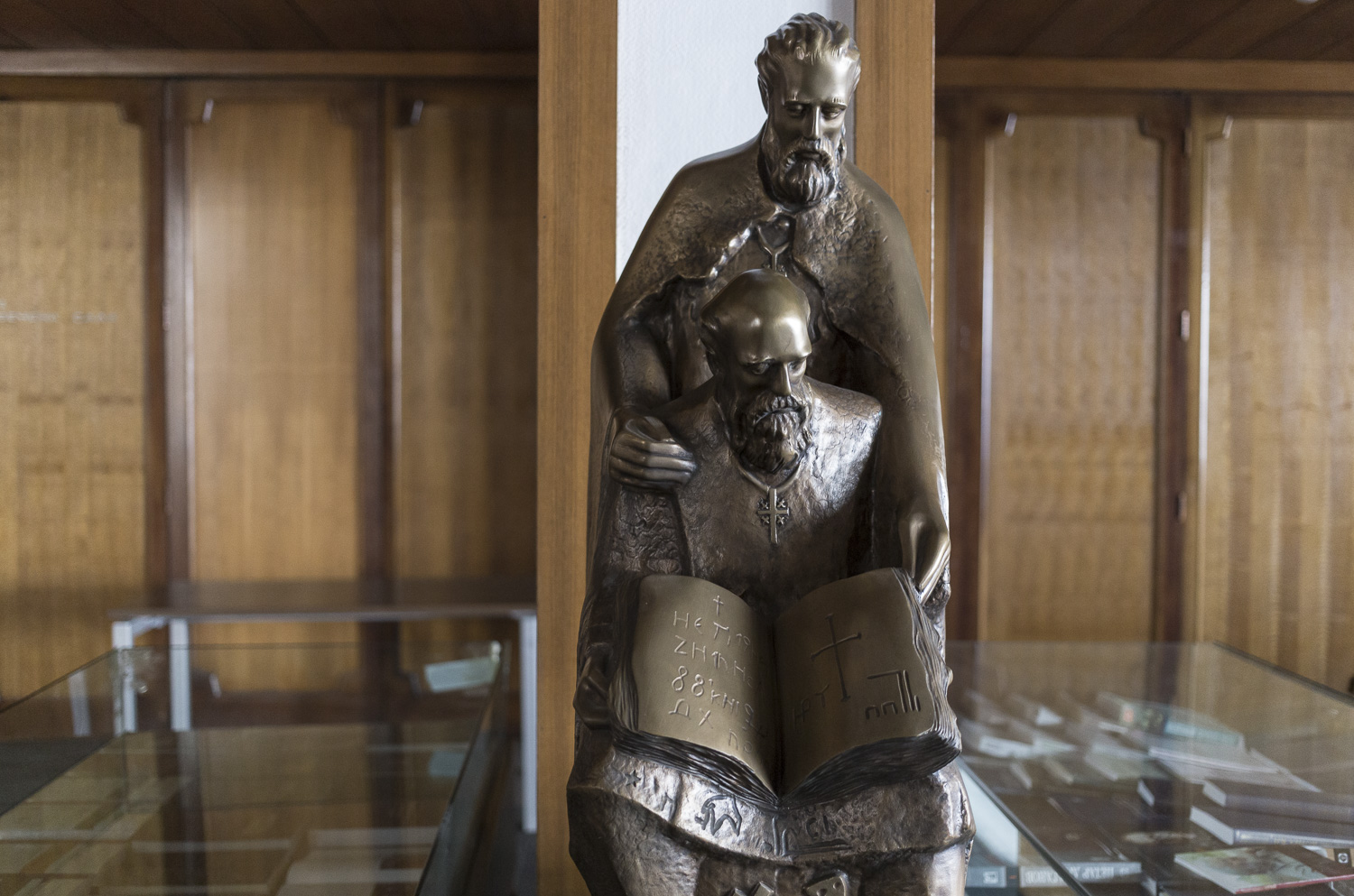
This year the Macedonian Academy of Sciences and Arts marks and celebrates a major jubilee—50 years of existence and work of our highest institution in the fields of science and the arts. Although 22 February 2017 marked 50 years since the Law on MASA was adopted by the Assembly of the Socialist Republic of Macedonia, and 10 October will mark 50 years since the ceremonial constitution of MASA, we proudly emphasize that our roots—the roots of Macedonian and Slavic cultural and spiritual continuity—reach much further back, across a time span measured in centuries. The mission of Saints Cyril and Methodius, and the historical events that enabled Ohrid, with its renowned Ohrid Literary School, to become a centre of Slavic educational and enlightenment activity as early as the ninth century—activity that subsequently spread throughout the Slavic lands—fundamentally transformed our contribution to the treasury of European culture and civilization. Centuries later, toward the middle of the nineteenth century, the Macedonian national revival began, led by a constellation of our cultural and national figures. At the beginning of the twentieth century, these processes resulted in the establishment of the Macedonian Scientific and Literary Society in Saint Petersburg, led by Dimitrija Chupovski and Krste Petkov Misirkov, whose rich scientific, literary and cultural activity represented an important reflection of our spiritual continuity and identity and an event that marked the germination of the Macedonian Academy of Sciences and Arts. This continuity continued and was sustained between the two world wars through a constellation of creators in literature, fine arts, music, philology, economics, law and technical sciences. A few years after the Second World War, in 1949, the first state university—Ss. Cyril and Methodius University—was established in the free Republic of Macedonia. In less than two decades, it built a strong human-resource base that enabled the rapid development of higher education and scientific activity in our country. This was an event of exceptional importance for the establishment of MASA as the highest institution in the fields of science and the arts.
This millennia-long course and continuity in the development of art and scientific thought in our lands demonstrates and proves that we are not a people without our own roots, history or culture, and that attempts to deny our identity, language or name, regardless of where they come from, are remnants of Balkan anachronisms and, in essence, absurd and retrograde.
Immediately after the establishment of MASA, a period of rapid development, diversification and enrichment of its scientific research and artistic creation followed. Less than two decades after its founding, MASA entered a phase of maturity and grew into, and established itself as, a cornerstone of Macedonian science, language, culture and history, as well as one of the pillars and symbols of the statehood of the Republic of Macedonia.
Today, by virtue of its integrated concept, structure and functioning, MASA possesses all the essential attributes of a modern European-type national academy and, naturally, performs the three fundamental functions characteristic of European national academies: creating a forum for the exchange and confrontation of different views and opinions on important issues in science and the arts, conducting scientific research, and performing an advisory role.
Scientific research and artistic creation in fact form the backbone of MASA's activities. The number of scientific research projects and projects in the arts carried out within MASA is impressive—more than 1,000 projects over the past 50 years. Some of these are long-term projects, mainly related to strategic issues of particular national interest, while a significant number involve fundamental and applied research in all fields of science and the arts represented in the Academy. MASA members increasingly incorporate an international dimension into their research activities: over the past several years, more than 60% of scientific papers have been published in international journals, most of them in impact-factor journals, while 50% of papers published in proceedings of scientific and professional conferences relate to events held abroad, and so on. Likewise, works by our renowned writers and poets who are members of MASA are translated into foreign languages and included in international anthologies. Our prominent painters and sculptors from both older and younger generations have created and continue to create outstanding works of art that are regularly exhibited at home and abroad. It should be emphasized in particular that our two research centres—the Research Centre for Energy and Sustainable Development and the “Georgi D. Efremov” Research Centre for Genetic Engineering and Biotechnology—which over the years have acquired a strong reputation in the region and beyond, continue successfully to maintain their standing. The work of the other research centres, including newly established ones that have begun implementing important international scientific research projects, is also being intensified.
During its half-century of existence and work, MASA has developed extensive publishing activity. From its establishment to the present day, around 700 titles have been published—monographs, results of scientific projects, conference proceedings, musical editions, facsimile and jubilee editions, joint editions with other academies and scientific institutions, publications from ceremonial gatherings, special editions of MASA departments, and similar works. The “Trifun Kostovski” Foundation, which has existed and operated for 18 years, also makes a particularly important contribution to MASA's publishing activity.
MASA proactively follows changes and new trends in the advisory function of modern European national academies and, in this context, the obligations arising from the SAPEA project—Science Advice for Policy by European Academies—initiated by the European Commission with the aim of intensifying cooperation among European academies in their advisory role. By publishing the results of our scientific research and presenting them to the broader scientific and professional public in the country, to government officials and others, MASA participates in shaping policies in science and the arts and in the country's overall development. At the same time, preserving MASA's independence and autonomy in performing its advisory role is our highest principle and priority.
Over the past period, MASA has developed extensive international cooperation, contributing to the affirmation of Macedonian scientific and artistic creativity and to enhancing the standing and reputation both of MASA and of the Republic of Macedonia internationally. Today our Academy cooperates with more than 30 foreign academies and scientific societies and is a full member of seven international associations of academies. In recent years, cooperation has intensified with the academies of neighbouring countries, with the Leibniz Scientific Society in Berlin, within the so-called Berlin Process (Joint Science Conference of the Berlin Process/Western Balkans Process), with the German National Academy of Sciences Leopoldina, with the French Academy of Sciences, with the academies of Southeast Europe, and others.
For the results achieved in its work, the Academy and its members have received numerous high domestic and international awards and distinctions. Over the past 50 years, MASA has received around 90 awards and recognitions—charters, plaques, certificates of appreciation, medals and decorations from domestic and foreign scientific, educational, artistic and other institutions. It should be emphasized in particular that MASA is a recipient of the high distinction of the Order of the Republic of Macedonia for its contribution to the development of scientific and research activity and artistic creation of importance for the development and affirmation of Macedonian science and statehood, awarded by the President of the Republic of Macedonia, as well as the prestigious “Samuel Mitja Rapoport” recognition awarded by the Leibniz Scientific Society of Germany—an award that was presented for the first time precisely to MASA. Today, 22 MASA members hold the status of foreign, corresponding or honorary members, or honorary doctorates, in around 60 foreign academies, scientific societies and universities.
***
The development trajectory of MASA clearly confirms that, during its fifty years of existence and work, the Academy experienced periods of flourishing as well as downturns and difficulties, directly connected with developments in Macedonian society—that is, with crisis periods of different kinds: the dissolution of the former common state (SFRY), problems surrounding recognition of the country's international legal personality after independence, embargoes and blockades in the early transition years, the internal conflict in 2001, and the political crisis of the past two or three years. In such periods of crisis and tension, criticism of the Academy also increased—claims that MASA is an institution closed in on itself, that MASA remains on the sidelines of current issues and developments in the country, and so forth. On the one hand, this reflects insufficient understanding of the Academy's social role: MASA is a leading scientific institution for which hasty, columnist-style reactions with a day-to-day political tone are not appropriate. On the contrary, MASA speaks through the strength of facts and arguments. MASA's core activity—the results achieved in scientific research and artistic creation—is our principal credential before the domestic and international professional and scientific public and, more broadly, before our society. On the other hand, such criticism and such a perception of MASA have a real basis in the fact that, despite the enormous body of completed scientific research and artistic projects, MASA has not sufficiently promoted the results of its scientific and artistic production to the public. This is a weakness that we must overcome in the future. Naturally, we cannot and must not turn a blind eye to other weaknesses and omissions that we have faced, at least from time to time, over the past 50 years and that we may face in the future—insufficient scientific criticism of developments in science and the arts, insufficient resistance to political influence, and the like. On the contrary, in the future we must clearly identify weaknesses and shortcomings in our work and find the right approaches to overcome them.
Today we live in a world of big science. The rapid development of science, the new technological model based on information and communication technologies, the new wave of entrepreneurial restructuring of economies and societies, and the globalization of world economic activity have opened new prospects for economic growth and development in individual countries and in the world economy as a whole. Yet these processes are inherently contradictory. The most recent global financial and economic crisis of 2007–2009 brought the contradictions of globalization and people's dissatisfaction with it to the surface: unequal distribution of wealth and power among countries, destruction of resources and the environment on a global scale, and the exhaustion of existing technological and development models. These processes also generated other problems—refugee and migration crises, the strengthening of regional and national protectionism in contrast to efforts to liberalize international trade, countries erecting walls at the beginning of the new millennium, and shifts in economic and technological power as well as in the geostrategic position and significance of entire regions and continents. Nevertheless, one fact remains: societies that strive to become knowledge-based societies and economies cope more successfully with the problems, challenges and risks facing the modern world. Of course, moving toward a knowledge-based development model presupposes major investment of resources in education, science, research and development, and culture, accompanied by well-conceived strategies for the development of these crucial spheres of the human spirit and civilizational survival. This fact undoubtedly underlines the special importance of national academies of sciences and arts in achieving such a goal.
In recent years, the Republic of Macedonia has faced the most serious political and social crisis since gaining independence. We are confronted with a crisis of institutions, violations of the principles of the rule of law, the phenomenon of a “captured state”, regression in the democratization of society, and a slowdown on the path toward Euro-Atlantic integration. The problems currently at the centre of our reality will require major reforms, considerable knowledge, energy and political will to overcome. In this sense and in this context, the role of MASA and of the country's overall scientific potential in overcoming the crisis is also of particular importance.
The above summarized assessments and reflections on MASA's development over the past 50 years, on the achievements in fulfilling its core activity, on the problems it has faced and continues to face, and on the major challenges imposed by the new era and determined by changes in the international and domestic environment, in themselves define the main priorities of our Academy for the coming period:
– Our long-term objectives are contained in MASA's mission and vision as the country's leading institution in science and the arts. MASA's mission is, through the development of the core functions characteristic of all modern European-type national academies, to make its full contribution to integrating Macedonian science and art into contemporary European and global currents, while our vision is for the Republic of Macedonia to become an advanced society based on science and knowledge;
– In the coming years, the focus of MASA's scientific research and artistic creation, in cooperation with other scientific research institutions in the country and with government experts, will be directed in particular toward elaborating issues and topics most directly connected with the sources of the country's current political and social crisis, in order to offer possible solutions, approaches and policies for overcoming it;
– Issues related to the Euro-Atlantic integration processes of the Republic of Macedonia, their continuous and thorough scientific monitoring and elaboration, and the active participation of MASA members in preparing the EU accession negotiations will remain a high priority on MASA's agenda. Our ultimate goal is for Macedonia to become a democratic, economically prosperous and multicultural European country;
– The increasing incorporation of an international dimension into MASA's scientific and artistic work—through cooperation with foreign academies, scientific societies and other scientific institutions, and through applications for and work on scientific projects financed by European funds and by other international and financial institutions—will likewise remain an important priority.
May we celebrate with pride the great jubilee—50 years of the Macedonian Academy of Sciences and Arts.