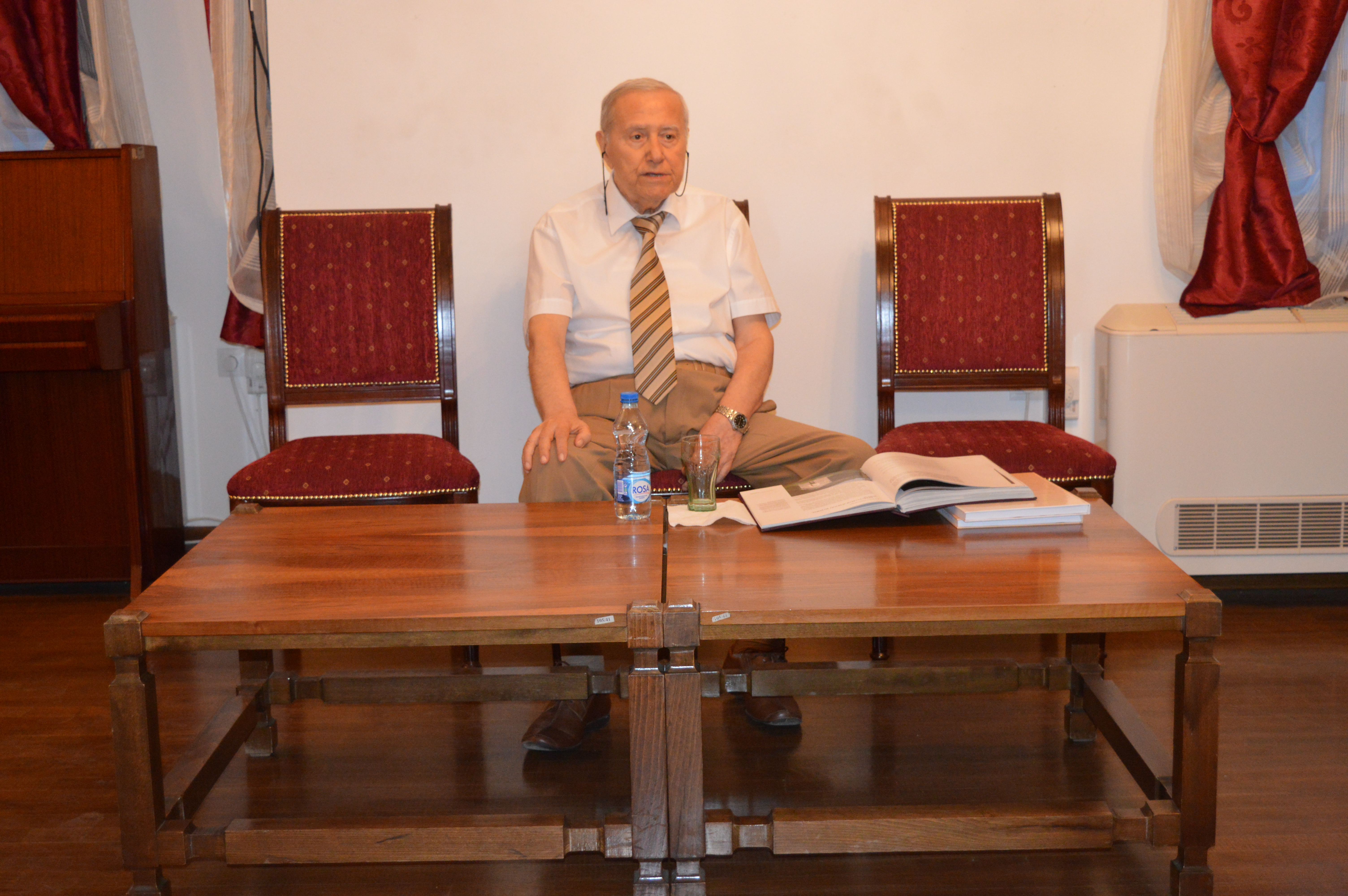
Lecture by Academician Cvetan Grozdanov: '1,000 Years since the Painting of St. Sophia'

On 15 July 2017, as part of the Scientific and Artistic Visit, Academician Cvetan Grozdanov delivered a lecture at the House of Urania in Ohrid on the topic 1,000 Years since the Painting of St. Sophia He first discussed the conservation of the frescoes during the 1950s, activities in which he had personally taken part during the summer months as a secondary-school student and as a member of the conservation team. These conservation interventions made it possible to remove layers of plaster and lime from the frescoes in the altar, nave and narthex of the church.
Academician Grozdanov focused primarily on the frescoes in the altar area of St. Sophia, which constitute the largest and best-preserved ensemble of 11th-century Byzantine fresco painting. He paid particular attention to the iconographic features of the compositions and individual representations of saints (Old Testament compositions, Eucharistic themes and the large number of ecumenical hierarchs, including the Slavic St. Methodius and St. Clement of Ohrid), and emphasized the ideological influence of the then Archbishop of Ohrid, Leo (1037–1056), evident in the conception of the themes and the selection of compositions and saints, particularly the Eucharistic themes and the depiction of the patriarchs of Constantinople and hierarchs of other Orthodox sees opposite the Roman popes in the apse of the diaconicon. The depiction of the Constantinopolitan patriarchs, including Patriarch Eustathius (1019–1025), is a key argument for establishing a precise chronology of the fresco painting in St. Sophia in Ohrid.
Regarding the fresco painting in the narthex, Academician Grozdanov noted that its painted programme and the dominant presence of female saints (approximately sixty) make it a unique gallery of female saintly portraits in Byzantine painting. Academician Grozdanov also discussed several Old Testament compositions that are very rarely depicted in medieval art; their appearance in St. Sophia ranks among their earliest representations and makes the overall painting of the narthex unique in Byzantine and medieval art.