Petar Hr. Ilievski
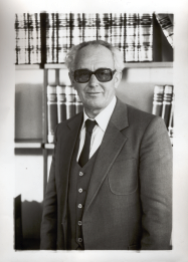
Full Member, 1983
Petar Hr. Ilievski
Биографија
Academician Petar Hr. Ilievski was born in 1920 in the village of Bigor Dolenci, Kičevo. He completed primary school in his native village and attended Orthodox theological seminary in Bitola. He then studied Orthodox theology in Sofia and graduated in 1946. As a student, he joined the National Liberation Movement in 1942 and the National Liberation War in 1944.
After the liberation, he worked as a secondary-school teacher. From 1952 he studied Classical Philology at the Faculty of Philosophy in Skopje, graduating in 1956, after which he was appointed Assistant at the Department of Classical Philology. He subsequently worked there as a professor until his retirement. During the 1957/58 academic year he undertook advanced studies in Cambridge, United Kingdom, where he worked on his doctoral dissertation, which he later defended at the University of Skopje.
His public and professional engagement was impressive. He organized the Society for Classical Studies of the former Yugoslavia and subsequently two scholarly congresses. He also organized the Seventh International Mycenological Colloquium in 1985, two international scholarly conferences devoted to Saints Clement and Naum, and other international academic meetings. At the same time, while still a student, he became involved in the work of the international journal
Živa Antika
, and later served for many years as its Editor-in-Chief.
In his scholarly work, Ilievski achieved outstanding results and international recognition in several related fields.
With his doctoral dissertation entitled
The Ablative, Instrumental and Locative in the Earliest Greek Texts
he achieved an international breakthrough in Mycenology. This was followed by a series of articles in the field, presented at eminent scholarly conferences and published in international academic journals. Among his more substantial works, the book
The Life of the Mycenaeans in Their Writ
ten Testimonies
stands out as a synthesis of his scholarly research up to that point.
As a classical philologist, Ilievski devoted attention to major themes in ancient literature and culture, with particular emphasis on meter in Homeric epic poetry and on the possibilities of rendering it in Macedonian. A notable work in this field is the book
On Ancient Prosody in Macedonian Poetic Translation
.
In his so-called Balkan studies, he achieved an unusual synthesis arising from his broad education. Among the large number of works published at home and abroad, especially important are those devoted to the study of Balkan languages from both diachronic and synchronic perspectives. His contributions on the Macedonian language occupy a central place and contain achievements of lasting significance.
A particularly valuable part of Ilievski's scholarly oeuvre is his research on the Macedonian language through the centuries, published in numerous articles and several books. In this context, the following works are of fundamental importance:
The Krnino Damaskin
and
Tradition and Innovation in Macedonian Church Slavonic Literary Monuments from the Ottoman Period.
These are complemented by works of fundamental importance devoted to the Cyrillo-Methodian tradition, some of which were published in the book
Unsetting Lights: The First Teachers of the Slavs and Their Disciples
, as well as by his participation in the first Macedonian translation of
the Gospel.
For his scholarly work, Ilievski received the highest state honors and awards, including the "11 October Award" twice. He became a member of MASA in 1979.