Ljuben Lape
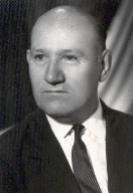
Full Member, 1976
Ljuben Lape
Биографија
He was born in Prilep on 11 October 1910 into a working-class family. He completed primary education in Prilep and secondary school in Bitola. In 1936 he graduated from the General History group at the Faculty of Philosophy in Belgrade. From 1936 to 1940 he worked as a teacher at the Commercial and Crafts School in Prilep; from 1940 to 1944, with interruptions, he was a teacher in Podgorica, Strumica, Elhovo and Panagyurishte. After the liberation of Macedonia, he first served as head of education at the Regional People’s Liberation Committee in Bitola, then as Assistant Minister of Education of the People’s Republic of Macedonia, and from 1946 onward as a professor at the Faculty of Philosophy in Skopje. In 1972 he was elected a corresponding member of MASA, and in 1976 a full member.
While still a student, he became involved in the progressive student movement in Belgrade, and in Prilep he served as President of the Student Society and participated in numerous cultural, educational and political activities in the city. As a result, he was persecuted and imprisoned by the anti-popular regimes of the former Yugoslavia. During the German fascist occupation he actively supported the National Liberation Movement morally and materially, for which he was arrested and imprisoned in the concentration camp at Chuchuligovo, Bulgaria.
Immediately after liberation, he was one of the organizers of Macedonian education and schooling, as well as of several cultural, educational and scientific institutions in Macedonia, including the Pedagogical Academy, the Institute of National History, the Archives of Macedonia and the Faculty of Philosophy. He founded the Department and Seminar of History at the Faculty of Philosophy in Skopje, where from its establishment onward he taught the history of the Macedonian people. At the same time, during the early years of the Institute of National History, he served as its part-time director.
He was among the initiators of the first historical journal in Macedonia, the Bulletin of the Institute of National History, and for many years served as its editor-in-chief. He was a member of editorial boards of Macedonian and Yugoslav journals. He contributed to the Encyclopedia of Yugoslavia and to the three-volume History of the Macedonian People.
He presented papers at all congresses of the Association of Yugoslav Historians and at three international congresses in Rome, Prague and Sofia.
Alongside his regular teaching at the Faculty of Philosophy and the postgraduate studies in the history of the Macedonian people in the 19th century, his principal scholarly interest was the modern history of the Macedonian people. Drawing on his research in Yugoslav archives and in the archives of France, the USSR, Bulgaria and Switzerland, he developed a periodization of the history of the Macedonian people and their historical development from the 6th century to the first decades of the 20th century. He published the results of his research in numerous articles, several collected volumes and individual books.
For his many years of organizational, cultural, educational and scientific activity, he received numerous decorations and awards. He was a recipient of the “Kliment Ohridski” Award and the “11 October” Award.
He died on 24 November 1985.