
Prof. Dr. Nataša Jonoska
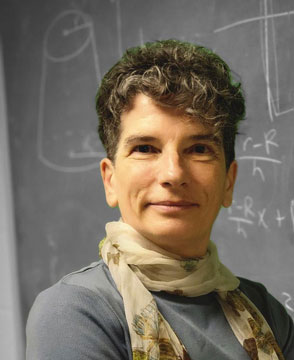
Member Outside the Working Composition, 2022
Prof. Dr. Nataša Jonoska
Биографија
Prof. Jonoska was born in Skopje, Republic of Macedonia, in 1961. She graduated in 1984 in mathematics and computer science from Ss. Cyril and Methodius University as the top student of her graduating class. The following year she was appointed Junior Teaching Assistant at the Institute of Informatics of the Faculty of Natural Sciences and Mathematics in Skopje, where she remained until 1988. She began postgraduate studies in mathematics with a specialization in computer science in Belgrade, in present-day Serbia, and soon afterward transferred to graduate studies at the State University of New York at Binghamton in the United States. There she earned a Ph.D. in Mathematics in 1993, specializing in symbolic dynamics under the mentorship of Thomas Head. Since August 1993, Prof. Jonoska has worked at the University of South Florida in Tampa, Florida, first as Assistant Professor until 1998, then Associate Professor until 2005, and subsequently Full Professor; since 2018 she has held the title of Distinguished University Professor. As a researcher, Prof. Jonoska has been a visiting scientist at New York University; several universities in France, including Paris, Orléans and Metz; the University of Milano-Bicocca, Italy; she was appointed
Van Vleck
Professor at Wesleyan University in Connecticut, USA, as well as
Blaise Pascal Professor
at Leiden University in the Netherlands.
Prof. Jonoska's scientific work has been recognized with several awards and honors. The University of South Florida awarded her
USF Presidential Excellence Award
in 2003, and the USF Outstanding Research Award in 2015. In 2007 she received the
Rozenberg Tulip Award
award from the association
International Society for Nanoscale Science, Computing and Engineering
for her achievements in the theoretical development of molecular models for computation in three-dimensional space and
their experimental validation. In 2014 Prof. Jonoska was elected a
Fellow
of the largest scientific association in the United States,
American Association for Advancement of Science
. Leiden University in the Netherlands appointed her
Blaise Pascal Professor
for 2015. In 2021, the Florida association
Mathematical Assosiation of America
presented her with recognition for
Distinguished College or University Teaching of Mathematics
, while the journal
Theoretical Computer Science
published a special issue in honor of her 60th birthday. In 2022
Simons Foundation
awarded her the prestigious
Simons Fellow in Mathematics
. Prof. Jonoska's research has been supported by numerous projects funded by
National Science Foundation, National Institute of Health, Simons Foundation, W.M. Keck Foundation
.
Prof. Jonoska is a member of the editorial boards of five scientific journals:
Natural Computing, Springer – Verlag; Theoretical Computer Science C, Elsevier Science; International Journal of Foundations of Computer Science, World Scientific: Computability, IOS – Press; Molecular Based Mathematical Biology, DE Gruyter;
and has served as a reviewer for numerous journals. She is a member of the steering committees of five international conferences and has chaired the committee of two of them. She has served as primary mentor to 7 postdoctoral researchers and 13 doctoral students, and as examiner or principal opponent for doctoral dissertations in many countries, including Australia, India, Italy, Canada, Norway, Finland and others.
Prof. Jonoska's research interests concern mathematical and computational models of biomolecular processes, particularly DNA rearrangement and recombination, RNA-DNA interactions, molecular-level information processing, and processes of self-organization and self-assembly. Her research methods are based on discrete mathematics, topological and algebraic graph theory, symbolic dynamics and automata theory.














