
Acad. Jordan Pop-Jordanov
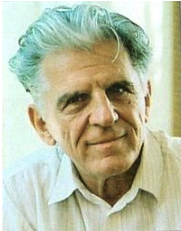
Full Member, 1974
Acad. Jordan Pop-Jordanov
Биографија
Acad. Jordan Pop-Jordanov was born in Veliko Gradište, Serbia, on 23 November 1925. He completed secondary school in Štip. In 1956 he graduated in philosophy from the Faculty of Philosophy in Skopje (average grade 9.94), and in 1960 in technical physics from the Faculty of Electrical Engineering in Belgrade (average grade 9.32). He obtained his PhD from the Faculty of Electrical Engineering in Belgrade in 1964. He undertook professional training in England, the Soviet Union and Switzerland. From 1960 he worked at the “Boris Kidrič” Institute in Vinča in several scientific positions and led a group of young researchers. In 1971 he moved to the Faculty of Electrical Engineering at the University of Belgrade, where he remained a full professor until the end of 1983, when he returned to Skopje.
At undergraduate and postgraduate level at the Faculty of Electrical Engineering in Belgrade, he taught atomic and statistical physics, energy microphysics and quantum electrodynamics. At the same faculty he also established a postgraduate programme in solar energy, the first of its kind in Yugoslavia. He also taught postgraduate courses at the Faculty of Natural Sciences and Mathematics and the Faculty of Philosophy, at the Center for Multidisciplinary Studies of the University of Belgrade, and at the Faculty of Electrical Engineering in Skopje. He authored the university textbooks Non-Equilibrium Statistical Physics (1981) and Quantum Electrodynamics (1983), as well as several books published in the country and abroad. He published around 300 scientific and professional papers, mainly in international scientific journals and monographs, chiefly in neutron physics, electrical engineering, energy and sustainable development, brain electricity and the philosophy of science. He participated in numerous international scientific meetings in around twenty countries across Europe, the Americas and Asia, most often as an invited expert. He carried out a large number of research projects, more than 20 of which were international. His results have been cited and used in numerous foreign articles, monographs and doctoral dissertations.
His principal scientific contributions relate to neutron science (the “Pop-Jordanov method” for neutron thermalization, published half a century ago in a prestigious United Nations publication); electric power engineering (multidimensional interpretation of environmental risks); solar energy (quantum models of thin films); sustainable development (the negentropic concept and mental indicators); neuroscience (brain electricity and quantum mental spectra); and the philosophy of the natural sciences (interpretation of microparticle dualism).
He is a member of editorial boards and a reviewer for several international scientific journals and international professional organizations, and has served as an evaluator in the appointment of professors at universities in Europe and the United States. He was editor-in-chief of the journal Radovi of the Institute of Physics at the University of Belgrade, and director of the International Postgraduate Summer School on Reactor Physics organized by the International Atomic Energy Agency.
He has received numerous awards, including the Annual Award of the Vinča Institute for Individual Scientific Achievement (1964); the Jubilee Award of the Vinča Institute for Development of a Scientific Field (1968); the WREN-UNESCO award for the best paper at the World Renewable Energy Congress in Denver (1996); the World Innovation Foundation award for outstanding contribution to science and humanity (2003); an award for outstanding contribution to twentieth-century science; and awards from the Universities of Skopje and Belgrade for best academic achievement, among others.
His decorations include the Commemorative Medal of 1941 (as a participant in the National Liberation War in Macedonia), the Order of Bravery, the Order of Brotherhood and Unity, the Order of Labour, three Orders of Merit for the People, the Order of Merit for Macedonia (2007), the Medal of the Macedonian Orthodox Church (2008), and others.
He served as President of the Scientific Council of the Institute of Nuclear Sciences in Vinča (1969–1970), at a time when the institute was the most renowned scientific center in Southeast Europe, and as Dean of the Faculty of Electrical Engineering in Belgrade (1977–1979). In 1993 he founded the Research Center for Energy, Informatics and Materials at MASA, which he headed until 2012 and which developed into an internationally recognized “center of excellence”. He was President of the Macedonian National Committee of the World Energy Council.
He is a member of five foreign academies: the New York Academy of Sciences (USA), the International Academy of Science (Munich, Germany), the European Academy of Sciences and Arts (Salzburg, Austria), the Mediterranean Academy (Naples, Italy), and the World Academy of Art and Science (San Francisco, USA).
He is an honorary member of the World Innovation Foundation and the Philosophical Society of Macedonia, and a foreign member of the American Physical Society, the European Section of the Society for Risk Analysis, the International Solar Energy Society, the Club of Rome–Council for the Future of Europe, the European Nuclear Society, the Society of Applied Neuroscience, and the European Society for Culture.
He was elected a corresponding member of the Macedonian Academy of Sciences and Arts on 25 December 1969 at its first regular electoral assembly, and a full member on 26 December 1974. From 1984 to 1991 he served as President of the Macedonian Academy of Sciences and Arts.
He speaks seven foreign languages.














