
Acad. Dragi Gjorgiev
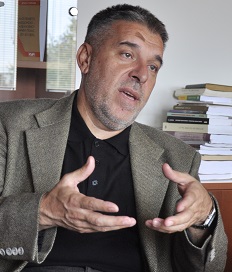
Full Member
Acad. Dragi Gjorgiev
Биографија
Corresponding Member Dragi Gjorgiev was born on 28 April 1963 in Strumica. In 1986 he graduated from the Department of History at the Faculty of Philosophy of Ss. Cyril and Methodius University in Skopje, and in 1988 he joined the Institute of National History as a Junior Assistant. That same year he enrolled in the Department of Oriental Languages at the Faculty of Philosophy of the University of Sarajevo, where he graduated in 1991. After returning to Skopje, in 1995 he completed his master’s degree at the Department of History of the Faculty of Philosophy in Skopje with a thesis entitled “Skopje from the Ottoman Conquest to the End of the Seventeenth Century.” That same year he was elected Assistant in the Department for the Ottoman-Turkish Period at the Institute of National History. In 2004, at Ss. Cyril and Methodius University in Skopje, he defended his doctoral dissertation “The Population in the Macedonian-Albanian Border Area in the Fifteenth and Sixteenth Centuries.” That same year he was elected Research Associate, in 2007 Senior Research Associate, and in 2010 Scientific Adviser in the Department for the Ottoman-Turkish Period at the Institute of National History. Since 2012 Corresponding Member Dragi Gjorgiev has served as Director of the Institute of National History.
The scientific research activity of Corresponding Member Gjorgiev is focused on the study of the Ottoman period. To date he has published 35 monographs and collections of documents, more than 50 articles in various journals and edited volumes, participated in several dozen national and international symposia, actively taken part in domestic and international scientific projects, and supervised several doctoral and master’s theses. Among his publications, particular attention is drawn to the series
Turkish Documents on the
History of Macedonia,
published by the State Archives of the Republic of Macedonia, in which eight volumes of Ottoman censuses relating to Macedonian history from the sixteenth and nineteenth centuries have so far been published. In addition to these censuses, which are primarily demographic and economic in nature, Corresponding Member Gjorgiev, thanks to his excellent knowledge of Ottoman Turkish, translates and publishes individual documents and books of Ottoman provenance relating to the history of Macedonia in the late Ottoman period. His translation activity also includes the two-volume collections “British Documents on the History of Macedonia,” Volumes IV and V (1857–1900). These extensive collections of more than 1,000 pages offer a unique picture of the demographic, political, and social conditions in Macedonia as seen through the eyes of British diplomats.
In 2009 Corresponding Member Dragi Gjorgiev published his doctoral dissertation as a monograph entitled
The Population in the Macedonian-Albanian Border Area in the
XV
–
XVI
Century
. Through several years of research into unpublished historical sources of Ottoman provenance, he traces demographic movements in the relevant border area and calls into question established theses in Balkan historiographies concerning dramatic and radical demographic changes in that territory during the stated period. This work, the first study of such scope based on relevant historical sources, represents an outstanding contribution to Macedonian historiography and undoubtedly attracted the attention of the wider historiographical community. Interest in this subject was further confirmed by the publication of an article on
The Population of the
Macedonian-Albanian Border Area in
XV
–
XVI
Century
, published in German in the renowned German
journal for Southeast European studies – Südost-Forschu
ngen (2008). In the same year, in Macedonian and English, he published a text on the history of the Macedonian people during Ottoman rule in the Institute of National History publication
A Short History of the Macedonian People
.
That same year, in the edited volume
The Balkans between Tradition and Modernity,
published in Sofia, he published the article
The Administrative Structure of the Salonica, Bitola and Kosovo Vilayets in the
second
half of the
XIX
Century
, which represents the most complete and exhaustive overview to date of the history of the formation and organization of these three vilayets, which encompassed the entire territory of Macedonia. It is important to note that this study was the result of the international project:
Administrative, Social and Cultural Institutions in the Balkan Ottoman Provinces in
XVIII
and
XIX
Century
, supported by the Ministries of Education and Science of the Republic of Macedonia and the Republic of Bulgaria, and carried out in cooperation between the Institute of National History and the Institute for Balkan Studies at the Bulgarian Academy of Sciences, with Corresponding Member Dragi Gjorgiev serving as the principal researcher on the Macedonian side.
In the period from 2010 to 2014, Corresponding Member Dragi Gjorgiev published several additional monographs, edited volumes and articles in the country and abroad, including a monograph on the Ohrid Ohrifzade family. Once again drawing on original Ottoman documentation, Gjorgiev provides a brief history of this best-known Ottoman family of Ohrid, whose descendants still live in Ohrid. In doing so, he raises an important question concerning the process by which the Ottoman aristocracy and elite were formed across the entire Balkan Peninsula: whether this was an authentic Ottoman aristocracy or a pre-Ottoman Christian aristocracy that gradually merged into the Ottoman world, embraced Islam and became part of the Turkish ethnic community. Without drawing absolute or exclusive conclusions, the study develops the thesis that the Ohrifzade family may in fact have been an old Christian family belonging to the medieval Christian aristocracy of Ohrid.
Another important and topical contribution from this period is his article on the name Macedonia during the Ottoman period, published in Poland in the journal of the Faculty of Artes Liberales at the University of Warsaw. Drawing on Ottoman, Slavic and other sources, the article examines the meaning and acceptance of the name Macedonia during different periods of Ottoman rule.
In addition to his scholarly work, Corresponding Member Dragi Gjorgiev has lectured at several universities outside Macedonia and has participated in approximately 50 international and national scholarly symposia, where he presented papers and took part in discussions on the history of Southeast Europe and the Ottoman Empire. The results of his conference participation over the preceding four years were published in Belgrade, Sofia, Istanbul, Ankara, Warsaw, Kraków and elsewhere.
As a result of his archival research in Istanbul and Ankara, which he began as early as 1993, he has brought back more than 10,000 photocopies of Ottoman documents relating to the history of Macedonia from the fifteenth to the twentieth century. This source material constitutes an exceptional foundation for studying the entire Ottoman period through original documentation of Ottoman provenance.
Thanks to his in-depth study of the Ottoman world, he became a member of the editorial boards of several international journals, a member of scholarly institutions such as the Turkish Historical Society, and a member of committees for the defense of doctoral dissertations.
He was elected a Corresponding Member of the Macedonian Academy of Sciences and Arts in 2015.
He was elected a full member of the Macedonian Academy of Sciences and Arts in 2022.














