Cvetan Grozdanov
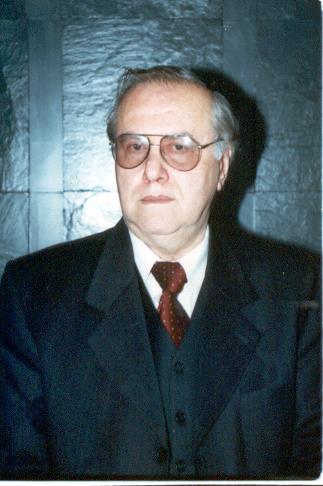
Full Member, 1996
Cvetan Grozdanov
Биографија
Acad. Cvetan Grozdanov was born on 5 March 1936 in Ohrid. While still a student at Kliment Ohridski High School in Ohrid, during the summer months he joined the conservation team cleaning the frescoes in the Cathedral of St. Sophia in Ohrid. He studied art history at the Faculty of Philosophy in Belgrade, graduating in 1961. His graduation thesis, ‘Newly Discovered Medieval Portraits in Ohrid’, was awarded the highest possible grade by the examination committee and recommended for publication in the Proceedings for Fine Arts, no. 2, Novi Sad.
After graduating, Acad. Cvetan Grozdanov undertook specialization in medieval and Byzantine art at the Faculty of Philosophy in Belgrade under Acad. Prof. S. Radojčić and Prof. V. J. Đurić, as a scholarship holder of the Government of the Socialist Republic of Macedonia. After completing military service, he worked as a curator at the People’s Museum in Ohrid. During this period he began the systematic collection of documentation on medieval wall painting in Macedonia and worked on the topography of sacred monuments in southwestern Macedonia, particularly in the regions of Struga, Debar and Prespa.
In the 1966/67 academic year, he received a scholarship from the French Government and undertook advanced study in the history of Byzantine art under Prof. A. Grabar at
College de France
in Paris. In 1966 he was one of the organizers of the monumental exhibition ‘Slavic Literacy – 1,050 Years Since the Death of Kliment Ohridski’. In 1969 he was elected assistant in Art History at the Faculty of Philosophy in Skopje. At the Faculty in Belgrade he defended his doctoral dissertation, ‘Ohrid Wall Painting of the 14th Century’. In 1980 he was elected Associate Professor and in 1985 Full Professor at the same faculty.
In addition to the Faculty of Philosophy in Skopje, Acad. Grozdanov also taught medieval art at the Faculty of Fine Arts. He held numerous duties and functions in public bodies in the fields of science and culture, as well as at the University. He served as Minister of Culture in the first Government of the Republic of Macedonia elected by the pluralist Assembly in 1991/92.
Over the preceding three decades, Acad. Cvetan Grozdanov carried out intensive scientific research. He presented at numerous scholarly meetings in the country and abroad, and his papers were published in scientific proceedings in Skopje, Belgrade, Zagreb and elsewhere. He lectured on medieval art in numerous cities throughout Yugoslavia, at the Kolarac People’s University and the Cultural Center in Belgrade, cultural centers in Zagreb, Split, Mostar, Subotica and elsewhere. He also delivered lectures in Paris at UNESCO, at the Academy of Sciences in Prague, and at universities in Thessaloniki, Istanbul, Rome, Naples and Sofia. At the 18th International Congress of Byzantine Studies in Moscow, he was entrusted with the introductory presentation at the round table ‘Yugoslav Saints in Orthodox Iconography’.
Academician Cvetan Grozdanov authored more than 300 bibliographic items published in Macedonian and other languages in domestic and foreign professional and scholarly journals. He discovered several medieval ensembles of fresco painting in Macedonia and identified numerous historical figures represented in the ancient art of the Balkans. Throughout Acad. Cvetan Grozdanov’s oeuvre there is a sustained interest in exploring Byzantine-Slavic cultural relations, above all in the visual arts, from Sts. Cyril and Methodius and St. Kliment Ohridski through the 19th century. His research largely encompasses the study of wall painting from the Middle Ages—9th to 14th centuries—and the later medieval period—15th to 18th centuries—in Macedonia and neighboring Balkan centers. Much of his work is based on field studies undertaken across several Balkan regions, above all in Macedonia and on Mount Athos. His scholarly communications are consistently accompanied by comprehensive academic apparatus and familiarity with the latest international research on Byzantine art. The chronological range of his research is very broad and covers monuments from the time of St. Kliment Ohridski, the Empire of Samuel and the Ohrid Archbishopric through the period of the National Revival. Thematically, his research encompasses several areas. The largest part of his oeuvre concerns the discovery, identification and study of portraits of Sts. Cyril and Methodius and their disciples—St. Kliment, St. Naum, St. Gorazd, St. Sava and St. Angelarius, known collectively as the Seven Saints. Within this broad thematic area, Prof. Grozdanov also studied portraits of all saints who held a primary or foundational cult among the Macedonian Slavs up to the end of the 18th century. A special part of his work is his synthesis of 14th-century fresco painting in Ohrid. Equally significant are his discoveries of unknown or little-known monuments of medieval art and his studies of other monuments in central and southwestern Macedonia.
For his scholarly work, Acad. Grozdanov received numerous awards, including ‘11 October’, the City of Skopje ‘13 November’ Award, the City of Ohrid ‘13 November’ Award, and others, as well as many decorations. In 1975, on the 150th anniversary of the founding of Matica Srpska, he received a silver medal for his collaboration with its Yearbook – Proceedings for Fine Arts in Novi Sad. In 1988 the Synod of the Russian Orthodox Church awarded him the Order of St. Vladimir the Great for his study of artistic links between Russia and Macedonia, and he also received the Blue Ribbon of the 6th Congress of Balkan and Southeast European Studies. For his monograph St. Naum of Ohrid, Acad. Cvetan Grozdanov received the Republic of Macedonia’s highest award for science, the Goce Delčev Award (1996). In 2005 the Macedonian Society of Intellectuals ‘Spiritual Konaci’ awarded him the ‘Velja Kutija’ Award for the book The Art of Western Macedonia in the 19th Century (2005). The Ukrainian Academy of Sciences honored Acad. Cvetan Grozdanov with the ‘Golden Fortuna’ distinction. The Bulgarian Academy of Sciences awarded him its highest decoration, the Marin Drinov Medal. In 2003 he was decorated with a medal of the State Institute for Strategic Studies of the Republic of Turkey. In 2005 he was elected a member of the Association of European Intellectuals.
In 2003 he was elected a Foreign Member of the Serbian Academy of Sciences and Arts, and in 2007 a Corresponding Member of the Montenegrin Academy of Sciences and Arts. In 2004 he was awarded the title of
doctor honoris causa historicae scientiae
(Honorary Doctor of Historical Sciences) at St. Kliment Ohridski University in Sofia, Bulgaria, and in the same year the title of
doctor honoris causa
(Honorary Doctor) at Taras Shevchenko University in Kyiv, Ukraine.
He was elected a Corresponding Member of the Macedonian Academy of Sciences and Arts on 7 May 1991 and a Full Member on 20 June 1996. From 2004 to 2007 he served as President of the Macedonian Academy of Sciences and Arts.